
Vinyl containment bags, emergency breathing bladders, containment liners and equipment covers all start with the same decision: which material. The answer determines which process can build the product, how the seams perform and which ratings you can meet. SealWerks provides flexible material welding services for PVC, urethane, TPU and other weldable films and coated fabrics, along with thermoforming for rigid sheet plastics and commercial sewing for heavy vinyl. Our manufacturing team helps you match the material to the process before tooling begins.

Each process works on a different group of materials, so the material you pick narrows your options early.
Some materials work with more than one process. PVC, TPU, PETG, EVA, TPO and CPVC can be both RF welded and thermoformed, which gives designers more than one route to the same part.

These flexible plastic RF weldable materials make up most of the products we weld and seal:
Our RF welding also covers EVA, TPO, PVDC, CPVC, methyl acrylate and additive-modified polyolefin grades, and we fabricate with TPE. Standard polyethylene and polypropylene are heat sealed rather than RF welded.
Engineered fabrics pair a woven base such as nylon or polyester with a plastic coating. The base carries the load and the coating makes the seal, so the coating decides the process. RF weldable fabric includes PVC coated polyester, polyurethane coated nylon and TPU coated polyester. Cloth-backed vinyl is typically stitched, which is why our commercial sewing team handles it. It is water-resistant, tear-resistant and easily cleaned.
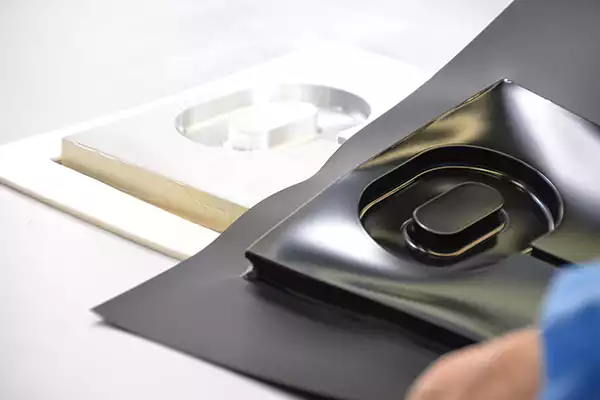
Thermoforming heats a plastic sheet and shapes it over a mold to make trays, guards, panels and packaging. Our thermoforming covers ABS, HIPS, HDPE, LDPE, polypropylene, polycarbonate and LEXAN, acrylic, KYDEX, PETG, RPET, rigid PVC, CPVC, Ultem, Royalite, Pennite, nylon, cellulose acetate, Aclar, TPO, TPU and EVA.
Our thermoforming materials guide compares properties and best-fit applications sheet by sheet. For the process itself, see our thermoforming services.
This table lists the soft goods manufacturing materials we evaluate for RF welding and thermoforming. The Details column links to pages that cover how we weld, seal or form that material.
| Material | Works with RF Welding | Works with Thermoforming | Material Details |
|---|---|---|---|
| Polyvinyl chloride (PVC) | Yes | Yes | RF welding of PVC laminated fabrics |
| Thermoplastic polyurethane (TPU) | Yes | Yes | RF welding of TPU films |
| Polyurethane (PU) | Yes | Yes | RF welding of urethane coated fabric |
| TPU-coated nylon | Yes | Yes | RF welding of urethane coated fabric |
| TPU-coated polyester | Yes | Yes | RF welding of urethane coated fabric |
| Polyethylene terephthalate (PET) | Yes | Yes | PET and PETG sealing and forming |
| Polyethylene terephthalate glycol (PETG) | Yes | Yes | PET and PETG sealing and forming |
| Ethylene-vinyl acetate (EVA) | Yes | Yes | Thermoforming materials guide |
| Thermoplastic polyolefin (TPO) | Yes | Yes | Thermoforming materials guide |
| Chlorinated polyvinyl chloride (CPVC) | Yes | Yes | Thermoforming materials guide |
| Polyvinylidene chloride (PVDC) | Yes | Yes | Thermoforming materials guide |
| Methyl acrylate | Yes | Yes | Thermoforming materials guide |
| Special RF-weldable polyolefin grades (additive-modified) | Yes | Yes | Thermoforming materials guide |
| Acrylonitrile butadiene styrene (ABS) | No | Yes | Thermoforming materials guide |
| High impact polystyrene (HIPS) | No | Yes | Thermoforming materials guide |
| High-density polyethylene (HDPE)* | No | Yes | Thermoforming materials guide |
| Low-density polyethylene (LDPE)* | No | Yes | Thermoforming materials guide |
| Polypropylene (PP)* | No | Yes | Thermoforming materials guide |
| Polycarbonate (PC) | No | Yes | Thermoforming materials guide |
| LEXAN | No | Yes | Thermoforming materials guide |
| Acrylic (PMMA) | No | Yes | Thermoforming materials guide |
| High molecular weight polyethylene (HMWPE)* | No | Yes | Thermoforming materials guide Heat Sealing |
| KYDEX (PMMA/PVC blend) | No | Yes | Thermoforming materials guide |
| Pennite (glass-filled nylon) | No | Yes | Thermoforming materials guide |
| Polyetherimide (PEI / Ultem) | No | Yes | Thermoforming materials guide |
| Royalite | No | Yes | Thermoforming materials guide |
| Reprocessed PET (RPET) | No | Yes | Thermoforming materials guide |
| Rigid PVC | No | Yes | Thermoforming materials guide |
| Nylon (polyamide) | No | Yes | Thermoforming materials guide |
| Cellulose acetate | No | Yes | Thermoforming materials guide |
| Cellulose nitrate | No | Yes | Thermoforming materials guide |
| Cellulose triacetate | No | Yes | Thermoforming materials guide |
| Aclar | No | Yes | Thermoforming materials guide |
*Heat sealable, not RF weldable. Polyethylene and polypropylene are joined by heat sealing.
Yes means the material responds to that process. No means the material does not respond to that process. Tell us the application and we will recommend a material that does.
Plastic material selection starts with the job the product has to do. These questions narrow the choice quickly:
Use this material selection guide as a starting point, then send your answers through the quote form and our manufacturing experts will recommend a material.
Many products must meet FDA, USDA, NSF, NFPA or other material ratings. These requirements affect which flexible materials qualify, so tell us which ones apply before we recommend a material. Typical flame ratings include:
SealWerks is an ISO 9001:2015 certified company, and material selection is part of how we design every product. Our design and engineering team recommends materials based on what the product must hold, resist or survive, and product prototyping tests fit and function before production. See how a project works and review our quality assurance process.
RF welding is used to bond compatible thermoplastic materials, including PVC, TPU, certain polyurethane and urethane-coated fabrics, and select specialty films and foams. Not all plastics respond to RF energy, and material compatibility depends on the specific formulation and application.
Unlike RF welding and heat sealing, which join compatible materials together, thermoforming uses heat and forming tools to shape one piece of plastic into a desired configuration. Many plastics that cannot be RF welded, like ABS, HIPS, polycarbonate and acrylic, may still be suitable for thermoforming, but the two processes serve different manufacturing purposes and produce different results.
At SealWerks, we evaluate your material, product design, and application requirements to help determine the most appropriate manufacturing process.
Standard polyethylene (PE) and polypropylene (PP) are generally not suitable for conventional RF welding because they do not respond effectively to RF energy. However, certain additive-modified polyolefin grades may be formulated for RF welding.
PE and PP can often be joined through heat sealing, depending on the material formulation and application. These materials can also be thermoformed into specific shapes, although thermoforming is a separate manufacturing process used to shape plastic rather than bond materials together.
The right manufacturing process starts with your intended result. Whether your project requires bonding materials, forming a specific shape, or assembling multiple components, the finished product’s design, function, and performance requirements help determine the best approach.
Material compatibility is equally important. RF welding, heat sealing, thermoforming, and commercial sewing each have different capabilities and limitations. Share your product concept, intended application, and material requirements with our team, and we’ll help determine the most suitable manufacturing process for your project.
Yes. Many products combine materials to improve function or design, such as an RF welded bladder with sewn straps and webbing. Our team can advise on which combinations bond well.
Yes. Many products must meet FDA, USDA, NSF, NFPA or other material ratings, and those requirements shape which materials we recommend. Typical flame ratings include NFPA 701, ASTM E-84 Class A, CSFM Title 19 and UL 94. Tell us which ratings apply early.
Send what the product must hold or protect, the conditions it will see, any ratings it must meet, an approximate quantity and a drawing or sample if you have one. We do not have a formal minimum order quantity. Quantities are set during quoting.
Tell us what you are building and what it needs to hold or protect. Our manufacturing experts will recommend a material and process and prepare a quote. Use the form below or call 847-439-4565.